
How do I get bones in Dungeon Settlers?
Hunt dungeon creatures and process what they drop. The barren colony does not run a bone farm. Mark corpses / parts, pick them up, dump on the ground at camp, and let storage haul.

Dungeon Settlers resource loop: bones, clay, and carapace are dungeon-gated. Haul ores and herbs from floors and merchants, not a barren-land farm.
Bones, clay, carapace — the dungeon is the mine.
~9 min read
This Dungeon Settlers resources page is the lookup for why the colony cannot feed itself, why bones / clay / carapace keep showing up in search, and how Z gather / C pickup actually move loot. The surface is barren land with little besides twisted trees. The dungeon is the mine: ores, herbs, wood, monster parts, gemstone veins, and merchant stock all come from expeditions. Verified September 5, 2026 · Early Access · Sep 4, 2026 · Steam.
Dungeon Settlers does not run a peaceful overworld farm loop. You settle, you research, then you send up to four people downstairs. Treat this wiki as a logistics map: what to mark, what to drop on the ground, and what never to auto-eat.
| Fact | Detail |
|---|---|
| Colony yield | Barren land — twisted trees on the surface; almost everything else is dungeon-gated |
| Dungeon yield | Bones · clay · carapace · ores · herbs · wood · Steam-listed gemstone veins, mandrake, golem / acid-bug rooms, merchants |
| Gather | Z enter gather · drag to mark · X cancel |
| Pickup | C enter pickup · drag boxes · optional auto-pickup |
| Storage | Hauls from the ground (and storage buildings), not from other units’ packs |
| Food policy | Do not auto-eat high-tier food — reserve it for diet and mood |
| Related | Expedition · equipment · research · mood & stress |
Matched by build plan, shared topics, and guide progression — not random related links.
Official copy for Dungeon Settlers is blunt: you build a settlement on barren land because Dungeon Core Arcteon is turning the continent into a dead zone. Steam and the in-game loop agree on the consequence. Surface trees that still grow are twisted. You can cut some wood at camp, but you cannot treat the home map as a complete resource biome. Bones, clay, carapace, most ores, herbs worth cooking, and the rare nodes players screenshot all sit on dungeon floors.
That split is the whole economy. Settlement spends materials. Research unlocks stations that spend more materials. Equipment ladders (wood → bone → carapace → metals) only exist if you keep sending a four-person party downstairs. If a new player farms the home trees for an hour and wonders why recipes stay grey, they are playing the wrong map.
Camp is for walls, indoor rooms, beds, research labs, kitchens, and storage classification. It is also where you drop the haul so haulers can see it. Do not expect a second “peaceful region” in current Early Access — the first two dungeon regions are the content that feeds the colony.
Every planned craft should start with a portal loadout, not a farm plot. Ask: which floor type drops the bottleneck, how heavy is the stack, and can the party extract before mood & stress collapses. Weight and stay time are resource costs even when the node is free.
Search tails for dungeon settlers bones, clay, and carapace exist because those three names sit on early weapon, furniture, and station recipes. They are not flavor text. Bone and carapace are the monster-part ladder after wood. Clay shows up in ceramics-adjacent builds and early industry. Exact recipe trees stay version-sensitive in Early Access — treat specific counts as TBA until you open the station — but the source is stable: you kill, harvest, or break things in the dungeon, then process at camp.
Ores, herbs, and wood sit beside those three. Wood still includes twisted-tree logs at home plus dungeon lumber (including named woods that appear in changelogs). Herbs feed cooking and some medical crafts. Ores unlock the metal side of equipment once research opens the right furnace or anvil.
If a recipe wants carapace and you have a pile of bones, you do not have a “generic monster parts” bar. You have the wrong corpse type. Mark the creature class that dropped the last carapace, then plan the next expedition around that room instead of wandering for mixed junk.
Raw drops often need a workstation. Units only treat items in their own pack, on the ground, or in storage as valid materials. A second settler standing next to the bench with clay in their bag does not count. Drop first, then queue the craft.
The gather loop is a mode, not a single click. Z puts you in gather: drag a box over trees, veins, herbs, or harvestable props and settlers will path to those jobs according to work priority. X cancels the mode and the marks you do not want. C is pickup: drag over ground piles so haulers or the selected unit collect them. Both gather and pickup support drag selection. Pickup can be set to auto-grab nearby items so you are not painting every coin.
Use gather on the dungeon node, pickup on the aftermath. Players who only C-spam corpses and never Z-mark a gemstone vein will starve the metal ladder. Players who Z-mark everything including aggro props will fight the room they meant to skip.
Strength feeds mining and woodcutting proficiency. Perception feeds farming and cooking. Intelligence feeds research and medical work. That does not mean your best fighter must never touch a vein, but it does mean a Perception cook should not be your only miner if you are racing copper. Set per-member job priorities at camp before the portal, not mid-fight.
X is how you abort a gather box that just included an elite pack. Pause in combat, cancel the job, reposition, then re-mark only the node. Gathering during an active fight is how haulers walk into acid.
After a portal return, loot often lands on the ground. Storage buildings auto-haul category-matched piles from the ground (and from storage they already own). They do not reach into another unit’s backpack and vacuum it. You also cannot treat a teammate’s pack as a shared crafting chest. If the iron is on the fighter and the smith is at the anvil, drop the iron.
This is the most common “the game is broken” report that is actually a logistics rule. Build enough category storage near the portal drop zone. Teach yourself a ritual: extract → dump → let haulers work → then queue crafts. Skipping the dump step looks like missing recipes.
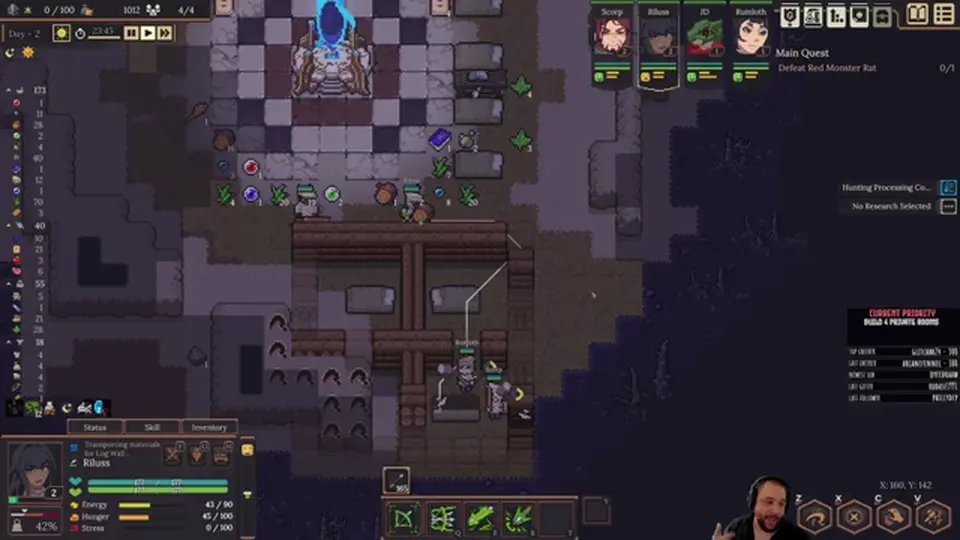
Items have weight. Overloaded and Severely Overloaded slow movement. A hero who scooped every carapace will not make the portal room in time, and a missing member is treated as dead. Dump mid-floor if you must. Empty space in storage is cheaper than a permadeath.
Own backpack, ground, storage. That is the list. Plan dumps before you open Task Planner. Infinite queues will idle if the only copy of a mat is sitting on a sleeping Elf.
Steam’s dungeon copy is a shopping list, not flavor. Gemstone veins are why you bring a miner and empty weight. Mandrake is a named harvest, not a camp crop. Giant golems and acid-spitting bugs sit on the same floors as the good nodes — the mine is guarded. Traveling merchants let you convert a lucky haul into a missing mat without another full clear, at the cost of carrying trade goods and not dying on the walk back.
Deeper floors roll rarer nodes and nastier guards. Randomized rooms mean you cannot pin a vein to a fixed map pin. You can pin a policy: mark veins when you see them, do not start a golem if stay time is already red, and always check merchant stock before you fill the last weight slot with junk wood.
Steam also mentions ancient trees that want blood for forbidden fruit. Treat those as expedition events, not a farm. If you spend a member’s health for a fruit, you have bought a consumable with permadeath risk. Log the trade; do not automate it.
Buy bottlenecks, not bulk. Camp crafting plus research is the volume path. Merchants are the patch for a single missing stack that would otherwise force another deadly floor.
Dungeon Settlers lets you allow or ban auto-consume per food and medical item. Do not auto-eat high-tier food. Premium meals are mood tools and race-diet tools. If everyone is allowed to snack them at hunger ticks, your Elf never sees the meat-free plate you cooked, your deep-run rations vanish on a calm camp day, and mood & stress still tanks downstairs because the good food is gone.
Hunger at zero is not a snack prompt. It becomes Severe Hungry, then Near Death, and the unit loses control until someone feeds them. That is a rescue, not an auto-eat. Keep cheap staples on auto. Lock stews, barbecues, and specialty race dishes behind manual or a narrow allow-list.
Dungeon stay punishes long clears. Food is how you fight that curve. Count meals per person per expected day, then add a feeder ration for the Near Death case. Weight spent on luxury food that will be auto-eaten at camp is weight you did not spend on Aid Kits.
Elf meat penalties and Lizardman vegetable penalties mean “food” is not one pile. Cook and store by diet. See the mood & stress page for the stress death chain; this page only insists you stop the warehouse from eating the solution.
Marking nothing and hoping corpses auto-sort. Leaving the haul in backpacks. Auto-eating the only good meals. Extracting without the whole party in the portal room. Fighting a gemstone room at hour twelve because the vein looked pretty. Each of those turns a successful fight into an empty warehouse or a dead roster.
The fix is boring and it is the loop on this page: Z / C / dump / storage / banned auto-eat / short stay. Pair it with beginner guide on day one and expedition for depletion and portal rules.
If mood is negative and stress is climbing, the node is not free. A living party farms the next vein. A collapsed party farms nothing. Cut the gather box, walk the portal room, dump at camp, then research while they sleep.
Spend the haul on research unlocks and equipment ladders, then plan the next expedition around the missing stack — not a random floor.
Hunt dungeon creatures and process what they drop. The barren colony does not run a bone farm. Mark corpses / parts, pick them up, dump on the ground at camp, and let storage haul.
Dungeon rooms and creature types — not the twisted-tree surface. Treat them as separate bottlenecks, not a generic “monster parts” bar.
Z gather mode (drag-mark nodes), X cancel, C pickup mode (drag-mark piles, optional auto-pickup).
Auto-haul reads the ground (and storage), not another unit’s backpack. Drop the pile, then wait for the matching storage building.
No. Ban high-tier meals from auto-consume so race diets and dungeon rations survive.
Matched by build plan, shared topics, and guide progression — not random related links.